The Dry Drowning
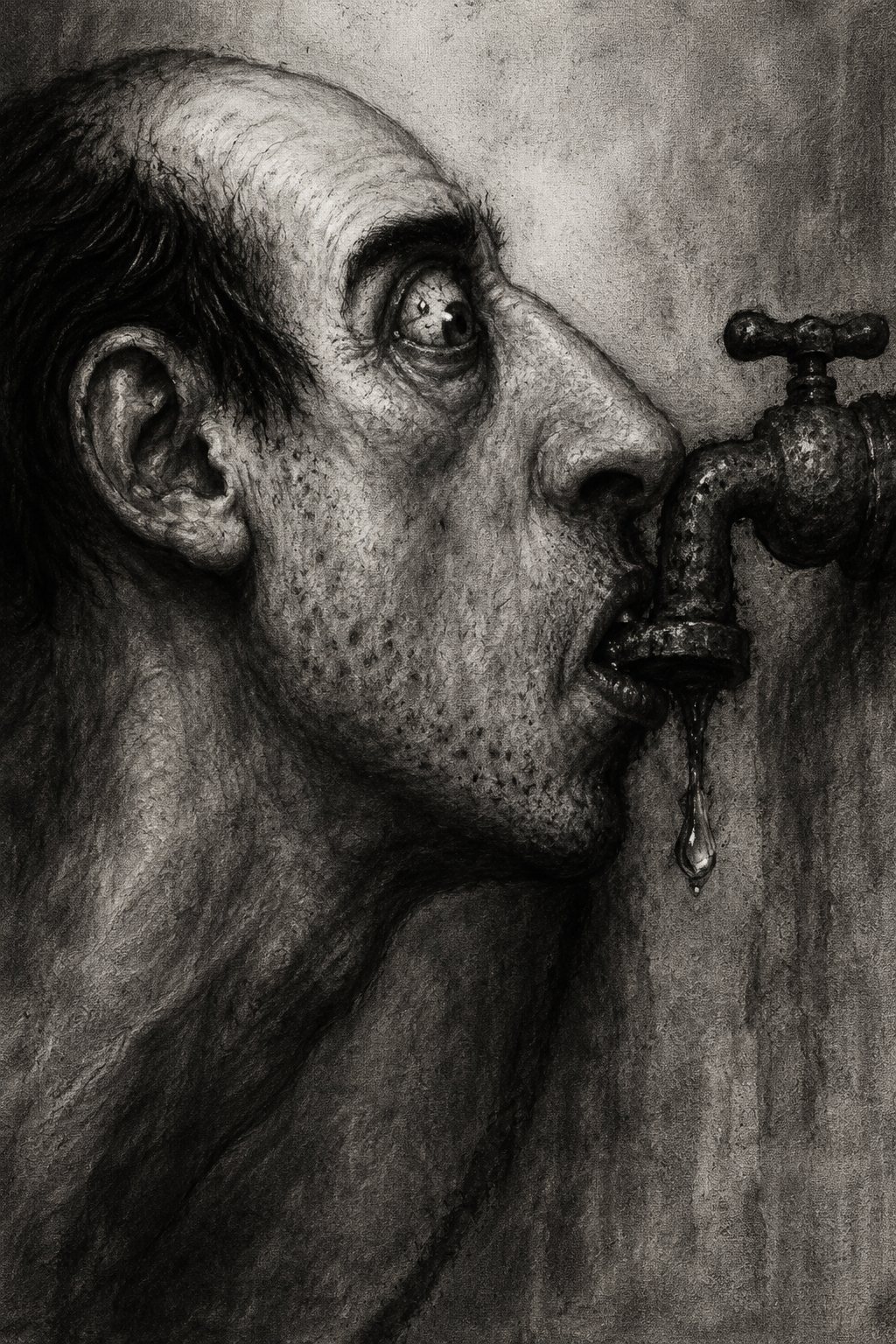
THIS IS A WORK OF FICTION
The first body was found in Tower B, flat 19C, sitting upright in an Italian massage chair with his newspaper folded neatly on his lap and his lungs full of water.
Outside, Southern Avenue had become a brown argument. Rain bounced off bus roofs, hissed from tram wires, and turned the hawker tarpaulins into sagging blue cheeks. A tea stall under the half-dead krishnachura tree had three men sharing one bench and twelve opinions. The frying oil smoked. Someone’s umbrella turned inside out and became, for one glorious second, a black flower of defeat. Cars crawled past the entrance of Jaladhar Heights with their headlights on, as if entering a cave.
Madhab Porel stood at the security gate holding a broken PVC elbow in one hand and the morning’s milk packets in the other. The gate guard, Bappa, had abandoned his chair to watch the rainwater run into the special imported channel beside the driveway.
“See, dada,” Bappa said, “foreign intelligence. Rain comes here, goes there. Not like our municipality, where rain comes and remains until Durga Puja.”
The channel swallowed water without a gurgle. It was lined with pale stone and steel mesh, too clean for Calcutta. Above it, on a polished brass plate, the words EUROCLIME AQUA-SENSE PASSIVE HARVESTING SYSTEM shone with the confidence of things purchased in euros.
Madhab did not trust any system that called itself passive.
He had been the caretaker of Jaladhar Heights since the foundation was a crater and the old houses behind Deshapriya Park were still being chewed into gravel. Before that he had been a plumber’s helper in the same para, thin as a bamboo pole and happy enough to eat muri from yesterday’s newspaper. Now he was fifty-four, with a paunch, a rent-controlled room in Kasba, and knees that predicted rain better than the Meteorological Department.
The residents liked him because he came when called and did not speak unless necessary. The managing committee liked him because he knew which valve controlled which tower, which pump made which noise, and which domestic worker had borrowed whose spare key. Madhab liked nobody in particular but was kind to almost everyone, which in Calcutta passes for sainthood if maintained for more than six months.
On the day Mr. Anirban Sen drowned in his dry drawing room, Madhab had been in the basement checking the rain tanks.
They were beautiful, in the way rich people’s useful things are beautiful. Four black cylinders taller than buses, ribbed like sleeping whales, each connected to filters, gauges, copper pipes, and a central listening chamber the engineers called the “decision column.” The system decided whether water should be cleaned, stored, pumped to flush tanks, sent to garden lines, or released into the storm drain. It did this without electricity, the German consultant had said proudly. Pressure, membrane, weighted floats, mechanical logic.
“Like a brain,” Mrs. Laha from 8A had said.
“Like a toilet with delusions,” Madhab had muttered later.
That morning, the decision column ticked softly. Not the usual pump tick. This was patient, articulate. Tak. Tak-tak. Tak.
He put his ear near the pipe.
A voice said, “Nineteen C.”
It was not a human voice. Not exactly. It had the flatness of water poured from a steel jug. Madhab jerked back so hard his shoulder struck the filter housing.
Then Bappa’s call came from the intercom. “Madhab-da! Emergency. Mr. Sen not opening. Madam screaming like anything.”
By the time the door was forced, Mrs. Sen had fainted in the corridor. Mr. Sen sat in his chair in a white kurta, mouth open, eyes surprised but not terrified. There was no spilled glass, no leaking ceiling, no wet carpet. The air smelled faintly of pond water and expensive room freshener losing a private war.
The doctor from 12B came in, listened, pressed, lifted an eyelid, and said what doctors say when life has left without signing the visitors’ book.
But when the ambulance men tilted the body, water poured from Mr. Sen’s mouth onto the dry marble floor.
Everyone stepped back except Madhab.
The water spread in a thin sheet, found the grout lines, and ran toward the powder-room drain.
Three days later Mrs. Lalita Laha from 8A drowned in her bed.
She was seventy-two, former headmistress, widow of a famous lawyer, owner of twelve silk shawls and a tongue sharpened by decades of staff meetings. She had called Madhab the previous evening about a knocking sound in her bathroom wall.
“Not knocking,” she corrected when he arrived. “Tapping. There is a difference. Knocking is vulgar. Tapping has intention.”
He checked the sink, commode, shower mixer, flush tank. Everything dry. The pipes hummed faintly.
From the adjacent bedroom came the voice of her young maid, Piu, speaking to someone in a whisper. “No, I cannot ask now. She will shout. I’ll give after salary.”
Mrs. Laha’s face tightened. “These girls are always on the edge of theft. Poverty is no excuse for bad character.”
Madhab said nothing. In Calcutta, the old middle class had perfected a strange magic: people with leaking pensions still spoke like zamindars because at least someone poorer was available to be judged.
As he tightened a coupling under the basin, the wall tapped again.
Tak. Tak-tak. Tak.
Mrs. Laha turned pale.
“What is it saying?” Madhab asked before he could stop himself.
She looked at him sharply. “Pipes don’t say.”
That night she drowned under a dry bedsheet. Her pillow, mattress, hair, and nightdress were dry. Inside her lungs was nearly a litre of water, according to the police doctor, who did not use the word impossible because impossible creates paperwork.
The gossip began before the body left.
Bad heart. Stroke. Witchcraft. Imported system defect. Secret drinking. Covid aftereffect. Sons living abroad, what can you expect. Too much loneliness in these towers. Too much sealed air. Rich people die in air-conditioning like fish in plastic packets.
Piu sat outside the service lift, crying silently into her dupatta. Madhab gave her tea from the stall. She held the clay cup with both hands.
“She knew,” Piu said.
“Knew what?”
“That I take leftover milk powder. For my brother. But yesterday she said, ‘Ask properly, don’t steal like your father.’ My father never stole. He drowned in Ultadanga flood when I was small.”
Madhab looked toward the rain channel. Water moved beneath the steel mesh without a ripple, disappearing into the building as if into a throat.
“Did you tell her about your father?”
“No.”
“What else did she say?”
Piu wiped her nose. “She said the wall told her.”
By the third drowning, the residents stopped joking.
Mr. Vivek Agarwal of 3D was found in his prayer room, folded forward before a row of brass gods, lungs full, floor dry. His wife insisted he had been fasting. His son insisted the building water must be poisoned. His daughter whispered to the police that he had been receiving calls about unpaid contractor bills from the construction years. Nobody asked the drivers or cleaners, though they had known for months that Mr. Agarwal still owed money to half the men who had laid Tower B’s sewage line.
A meeting was called in the community hall, where the walls displayed framed photographs of Jaladhar Heights winning awards for sustainable urban living. Outside the glass doors, rainwater trickled through transparent pipes installed for display, charming as an aquarium. Children used to press their noses there and watch leaves spin down toward the basement tanks.
Nobody let children near it now.
Mrs. Sen came wrapped in white, her eyes raw. Piu stood at the back near the service entrance because grief has class seating. Dr. Sanyal from 12B arrived with medical seriousness and private excitement. The managing committee president, Mr. Ranjit Basu, wore a linen shirt and the expression of a man preparing to defend property value against superstition.
“We must be rational,” Basu said. “Three elderly residents. Monsoon season. Respiratory complications. Coincidence looks dramatic when arranged by fear.”
“Inside dry rooms?” Mrs. Sen asked.
“Human body is mostly water,” Dr. Sanyal said, then immediately looked sorry for saying it.
Bappa raised his hand. “Sir, basement pipe is talking.”
Nobody appreciated this contribution.
Basu turned to Madhab. “You maintain the system. Any malfunction?”
Madhab could have said yes. He could have said the decision column spoke apartment numbers in the voice of a pond. He could have said the water taps secrets through walls. Instead he looked at the polished floor and saw his own cracked sandals reflected there like two accusations.
“Pressure fluctuations,” he said.
Basu seized the phrase like a drowning man grabbing a priest. “Exactly. Pressure. We’ll call EuroClime’s Indian service team.”
“They already came last month,” Madhab said.
“For routine inspection.”
“For the black smell.”
The room quieted.
“What black smell?” Mrs. Sen asked.
Basu’s smile became thin. “A minor sediment issue.”
“It was not sediment,” Madhab said. “The tanks were clean. The smell came from below.”
“Below what?” Piu asked.
Madhab did not answer. He remembered a hot afternoon six years earlier, before the towers rose, when the excavation had gone deeper than the sanctioned drawings. The workers had found old brick steps under the mud, going down to a square of dark water. Not a pond exactly. A buried tank, perhaps from some vanished garden house, covered over by time and practical men.
The contractor had cursed. Basu, then developer’s liaison and now resident-president by some miracle of civic evolution, had come in his SUV. There had been talk of delays, permissions, heritage nuisance, extra pumping. Madhab, still hoping for permanent employment, had helped run pipes to drain it at night.
The water had resisted.
That was the only word for it. It clung to the pump hose. It came up black and cold in May. Once, near midnight, Madhab had heard a splash though nobody was near the pit. The next morning a labourer from Malda was missing. The contractor said the man ran away with advance money. Basu told everyone not to repeat rumours.
Madhab had repeated nothing.
A job is a small god. It demands offerings.
That night, after the meeting, Madhab went down to the basement with a torch, a wrench, and the old shame sitting in his chest like undigested rice.
The rain tanks breathed.
Not loudly. A faint expansion and contraction travelled through the cylinders. The gauges trembled. The decision column ticked.
Tak. Tak-tak. Tak.
“Madhab,” said the pipe.
He nearly dropped the torch.
The voice came through the copper line overhead, travelled along the wall, entered the floor. It was not one voice now but many thin ones layered together: flush water, basin water, roof water, mop water, rainwater rinsed from balconies where people shouted at servants and hid bottles and cried into towels.
“Madhab Porel,” it said.
He backed toward the stairs.
From the pipe near the garden valve came Mrs. Laha’s tone, dry and exact. “Tapping has intention.”
From another, Mr. Sen: “Tell her I sold the jewellery.”
Then a boy’s voice, not dead but old in Madhab’s memory, called from very far under the floor. “Dada, pull.”
Madhab shut his eyes.
There had been a boy. Of course there had. Not a labourer, not exactly. A helper. Fourteen perhaps, with a red thread round his wrist and a habit of singing film songs in a cracked voice. The night the old tank was drained, the boy had slipped on the brick steps. Madhab had heard him cry out.
Dada, pull.
Madhab had run to the edge. The water below had been smooth. The pump roared. Men shouted near the generator. Basu was on the phone. The contractor had yelled, “Don’t stop! If we stop now the wall collapses!”
Madhab had seen fingers on the last visible step. He had stepped forward.
Then the mud shifted under his feet, and fear, reasonable as an accountant, told him he would die too.
He had thrown a rope. Too short. He had shouted. Too late. The fingers disappeared.
By morning the pit was empty except for black mud, old coins, broken tiles, and one red thread caught in the pump grille. The contractor said nothing had happened. Basu gave Madhab a permanent post before Durga Puja.
Now the pipe said, “You remember incompletely.”
Madhab opened his eyes.
The concrete floor near the decision column darkened. Water did not spread over it. Rather the floor seemed to remember having been water. The torch beam shook.
“What do you want?” he whispered.
The answer came in taps from every pipe.
Open.
The service team arrived two days later: three men with clean shoes, laminated badges, and a cheerful inability to find supernatural fault in European engineering. They inspected filters, seals, valves, pressure regulators. They praised the installation. They recommended replacing a membrane assembly at significant expense.
Basu hovered over them. “So no danger?”
“Sir, water harvesting is very safe when maintained,” the senior technician said. “This model is used in Dubai also.”
Everyone relaxed slightly. Dubai is the Vatican of Indian aspiration. If something is used there, how can it drown your uncle in Ballygunge?
That afternoon, Piu came to Madhab in the pump room.
“My brother is missing,” she said.
He turned off the auxiliary motor.
“He delivers newspapers here sometimes. This morning he came to collect old bottles from flats. He did not come home.”
“What is his name?”
“Ratan.”
“How old?”
“Fourteen.”
The basement seemed to tilt.
They searched the stairwells, terraces, garbage room, parking levels. Bappa checked the CCTV monitor until his eyes watered, finding only rain distortion and the usual ballet of umbrellas. Basu objected to panic. Piu ignored him and ran through the service corridors shouting her brother’s name.
At seven, Madhab heard tapping from the pipe beside the drivers’ toilet.
Tak. Tak-tak. Tak.
He put his ear to it.
A boy whispered, “Dada, pull.”
Not memory. Present.
Madhab grabbed the largest wrench and ran to the rain channel outside the driveway. The storm had thickened into evening. Cars hissed past. The tea stall radio was playing an old song almost drowned by rain. He lifted the steel mesh with Bappa’s help.
Below, water raced toward the intake tunnel.
“Are you mad?” Bappa shouted. “You’ll be sucked in!”
Madhab climbed down.
The tunnel was not meant for men. He crawled on elbows and knees through cold runoff smelling of leaves, petrol, and something older. The pipe sloped toward the basement tanks. Twice his shoulder jammed. Once something brushed his cheek like hair.
He found Ratan caught at the grille before the first sediment chamber, alive, blue-lipped, his arm twisted through the bars. The water foamed around him but did not cover his mouth. It held itself back by an inch, trembling.
“Dada,” the boy gasped.
Madhab pulled. Ratan screamed. Bappa reached from above. Together they dragged him out into the rain, where Piu fell on him with such fierce sobbing that even Basu, arriving with an umbrella and outrage, went silent.
On Ratan’s wrist was a red thread.
Madhab stared at it until Piu snapped, “What? Never seen thread before?”
That night, Jaladhar Heights lost water pressure.
Flushes failed. Taps spat air. The garden sprinklers coughed black droplets. Residents came out into corridors in nightclothes, holding buckets, discovering with democratic horror that imported sustainability still required someone from maintenance to turn a valve.
Madhab did not answer calls.
He was in the basement, opening the sealed inspection hatch beneath the decision column. No drawing showed it. He had seen it once during construction: the old mouth of the buried tank, capped with reinforced concrete, hidden under the new system’s proud machinery.
Piu stood behind him with Ratan’s arm in a sling and a steel rod in her hand.
“You should not be here,” Madhab said.
“My brother should not have been in your drain.”
Fair enough.
Bappa came too, because fear is easier in company and because he liked Piu. Together they broke the concrete lip around the hatch. With each strike, the tanks groaned. Pipes knocked through all twenty floors. From above came shouts, then the frantic ringing of lift alarms.
When the hatch finally shifted, air rose from below.
It smelled of rain trapped before their fathers were born. Of moss. Of old brick. Of something shut away and taught manners.
Madhab lowered the torch.
Brick steps descended into black water. On one step lay old coins. On another, a white plastic key tag from Tower B. Lower down, half-submerged, were things the building had swallowed: a child’s marble, a gold earring, a strip of red thread, a contractor’s measuring tape, a school report card swollen into pulp, a packet of imported cigarettes, a pair of dentures.
And voices.
Not ghosts lined up like patients. Voices in the water itself, all secrets rinsed loose and mixed.
Mr. Sen selling his wife’s jewellery to cover market losses. Mrs. Laha hiding her son’s letters because loneliness made her cruel. Mr. Agarwal refusing wages, telling himself everyone cheats a little. Basu ordering the pit filled. The contractor laughing. Madhab shouting too late.
Then the drowned boy spoke from the steps.
“You did throw rope.”
Madhab gripped the hatch rim.
“I saw your hand,” the boy said. “Water saw also.”
Madhab began to cry without sound.
Basu arrived behind them, panting, furious. “Close that immediately! Do you know what structural damage you can cause?”
The water below rippled.
Piu turned on him. “My brother almost died.”
“Because this man tampered with equipment!” Basu pointed at Madhab. “He has always been unstable. Ask anyone. These lower staff create drama, then demand sympathy.”
There it was, the city’s oldest drainage principle: filth flows downward, blame faster.
Madhab stood. “You knew about the boy.”
Basu’s face changed by one careful inch. “What boy?”
“The one in the tank.”
Pipes began tapping overhead. Not one. Hundreds. Every bathroom, kitchen, flush line, garden pipe, fire line. The building spoke in rain.
Piu whispered, “It wants him.”
Basu stepped back. “This is absurd.”
The basement floor darkened beneath his shoes.
No water rose. No spray burst. The room stayed perfectly dry.
Basu made a small surprised sound and clutched his throat.
Madhab saw, in that moment, how easy it would be. Let the water finish its account. Let the man who had buried a boy be taken by the thing he buried. Justice, neat as a municipal stamp. The thought had weight. It had warmth.
Then he saw Ratan watching him.
Fourteen. Red thread. Eyes wide with the terrible education adults provide when they think children are not looking.
Madhab seized Basu around the waist and dragged him back from the dark patch. Basu fought him, choking, striking blindly. Piu screamed. Bappa pulled too. Together they hauled him toward the stairs.
The water did not follow.
Instead the blackness withdrew to the open hatch, disappointed but not angry.
Basu vomited water onto the dry floor. He lay gasping, alive, ruined.
Madhab went back to the hatch.
“I’m opening you,” he said. “Not feeding you.”
He turned the manual release wheel on the old storm-drain bypass, the one the contractor had sealed because it would send overflow into the half-forgotten municipal canal behind the property and stain the driveway during heavy rain. The wheel resisted. Bappa joined him. Then Piu. Then, astonishingly, Ratan with one good hand.
The valve screamed.
From under Jaladhar Heights came a long, muscular rush, as if the building had been holding its breath for six years. Water thundered below the floor, through the old brick tank, out through the bypass, carrying with it leaves, mud, coins, thread, secrets, and the cold patience of the buried rain.
Upstairs, every tap in every luxury kitchen opened by itself for seven seconds.
Later, residents would describe it differently. Pressure surge. Airlock. Illegal tampering. Divine warning. Media exaggeration. Basu resigned for “health reasons” before the police inquiry began. The contractor could not be found. The EuroClime system was declared damaged beyond economical repair.
The deaths stopped.
But in the first heavy storm of July, when the driveway flooded ankle-deep because the clever imported channel no longer swallowed everything, residents complained bitterly in the lobby. Their shoes were wet. Their cars smelled damp. Their property value had developed a cough.
Madhab, no longer caretaker, came to collect his final wages. Piu was waiting near the gate with Ratan, who had a new red thread and the solemn swagger of a boy recently rescued from myth.
From the open storm drain came the ordinary music of Calcutta rain going where it wished: gurgling, chuckling, carrying paan spit, flowers, petrol, and the loose change of human arrangements.
As Madhab stepped into the street, water ran over his sandals. For a moment it curled round his ankles like fingers.
Not pulling.
Remembering.